Showing posts with label smartphone. Show all posts

Thursday, July 30, 2015

UBreakIFix Boulder review: lots of thumbs up for this one

So, here's a shout out to a local business. I got my cell phone glass replaced yesterday, and after I got back to work, I checked the paperwork and I got the feeling that I had ripped them off. I called them back and told them that I still owed them $20. They told me not to worry about it. But they did fantastic work - perfect workmanship, good timing, great office manners, everything. I figured that the least I could do was tell all of you about them and encourage you to take your business there. That way they will more than recover the $20 they lost on me.
UBreakIFix Boulder (Facebook: https://www.facebook.com/uBreakiFix.Boulder?fref=ts and any browser: https://www.ubreakifix.com/locations/boulder) does repair work on cellphones, tablets, laptop computers, and other small electronic devices. They will do it by appointment or while you wait. Their prices are reasonable. Please give them as much business as you can. Just don't try to rip them off.


Tuesday, December 16, 2014

A Lunchtime Conversation With My Niece

I had a lunchtime conversation with one of my many beloved nieces. I reprint it here, for your viewing enjoyment.


I hope it's clear to you how much fun we have together.


Monday, October 28, 2013

HP calculators live on, small thanks to HP

UPDATE, 22 JAN 2024:

The Desmos product line continues to expand. Remember, these are all free apps. Their current offerings include:
The Desmos 3D calculator is an exciting new product! As of this update, the 3D calculator is still in Beta. But it is as intuitive as their original offerings. I typed in three equations: x = cos theta, y = sin theta, and z = theta, and the calculator plotted a nice spiral surface for me. No RTFM necessary. It just works!

Thomas Okken, the creator of Free42, has added another project to his page. Plus42 is an enhanced version of Free42. It's a paid app on Android and iOS, but is free for Mac, Windows, and Linux PCs. Please support his efforts by giving him money, one way or another.

The SwissMicros DM42, which runs Free42, is still being built and sold, and actively supported, and getting rave reviews online. I still want one.

In fact, the hardware and OS of the DM42 are so good, that it has proven to be infinitely customizable. The DM42 hardware serves as the host platform for other, new, open source calculators, such as the WP43, the C47, and the DB48X (yes, that's a "48"). These developments may deserve their own super-nerdy blog entry here on Zyzmog Galactic HQ. At the very least, in lieu of that blog entry, click on the links above and read about them for yourself.

The HP-12C (the Calculator that Refuses To Die) is still selling. Wikipedia calls it "HP's longest and best-selling product." HP has upgraded the HP-12C's innards several times now, so it keeps getting better and better. Other than the 12C, HP's calculator line is basically defunct.

TI continues to sell their ancient and overpriced TI-84 series to a captive market, but I think that their influence is finally waning, thanks to Desmos and others. TI doesn't appear to be pouring any more software engineering effort into improving their cash cow / golden goose. Let us wish TI a speedy march into oblivion.


UPDATE, 18 JUL 2022:

This is still one of the most widely read articles on my blog. That's gratifying. I'm glad to see that it is so useful to so many people.

The SwissMicros version of the HP42 drifts in and out of stock, as do the rest of the SwissMicros calculator product line. Don't let that worry you. It's merely a sign of the craftsmanship with which these beauties are built. (p.s. I want one.)

The Desmos calculators continue to march ahead. More power to them, I say, and to Eli Luberoff and his company. I hope that they make tons of money. Don't worry; their calculators are still free to you, and always will be.

And a final bit of good news: Free42 is not only alive and kicking after 15 years, but it is thriving! It is still in active development. The latest version was released a little over a month ago, in February 2020. If you have followed my recommendation and downloaded this little jewel, consider helping out by clicking on the Donate link on the Free42 webpage and sending Thomas a little cash.

UPDATE, 3 OCT 2019:

There's a Swiss company, SwissMicros, which makes absolutely beautiful replicas of some of the greatest HP calculators: the 10, 11, 12, 15, 16, 41, and 42. Yes, the 42.

There's a new game in town, and it makes the HP and TI calculators as obsolete as dinosaurs. Read this blog article about Desmos.

UPDATE, 27 SEP 2019:

This is one of the most widely read articles on my blog. It's good information. Since Apple did some housekeeping on their App Store, some of the picture links are broken. I've replaced them with local pictures.

In addition, Graphix48 has disappeared from the App Store. I wish I'd saved a local picture of it, because it was good. The developer's web page has also disappeared.

NOW, FOR THE ORIGINAL ARTICLE, 28 OCTOBER 2013:

The first pocket-sized scientific calculator in the world was the HP-35, invented by Hewlett Packard and introduced to the world in 1972. HP literally created the market for handheld scientific calculators. Although many worthy competitors arose, none could match HP's quality, reliability and overall superior design. HP was king of the mountain until Carly Fiorina chose to pull the plug on the calculator division sometime in the 1990s around 1999, and ceded the entire market to Texas Instruments.

Carly's excuse at the time was that "calculators are not profitable," which was an outright lie. We won't get into that here. That's water under the bridge. The geniuses who invented such dominant creatures as the HP-12C (the financial calculator that refuses to die), the HP-41 series and the HP-48 series, have moved on to other careers. So has Carly. Around HP, some people still spit after they say her name.

HP calculators have a vast and loyal fan base around the world. Some of those fans were later hired by HP to revive the calculator division, but it was too little, too late, and HP has never reclaimed the market. Like I said, that's a topic for another time, and besides, whining about it won't bring back the glory days.

One of the wisest things HP did, after announcing the dissolution of their calculator division, was release their ROMs into the wild. You can find ROM images, and maybe even source code, for many of HP's calculators online. I believe you can even find source code and emulators for the Saturn and other 4-bit CPUs at the heart of the calculators. (No, I won't include links. Go sniffing for them if you want them.)

Thanks to this wise and generous move by some key players inside HP (see the note at the end), their calculators live on. You can now have an HP calculator app on your iOS or Android device. These emulators work as well as the real things, including support for external storage and printers (on some apps).

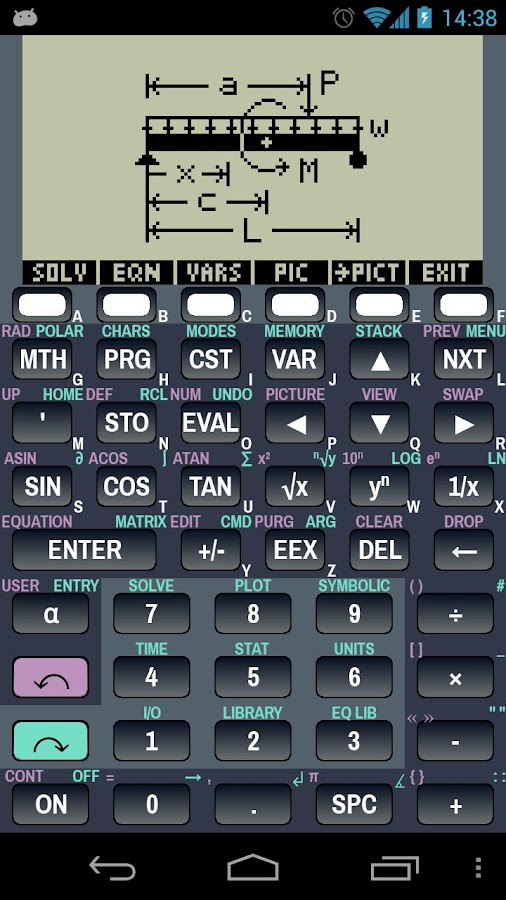
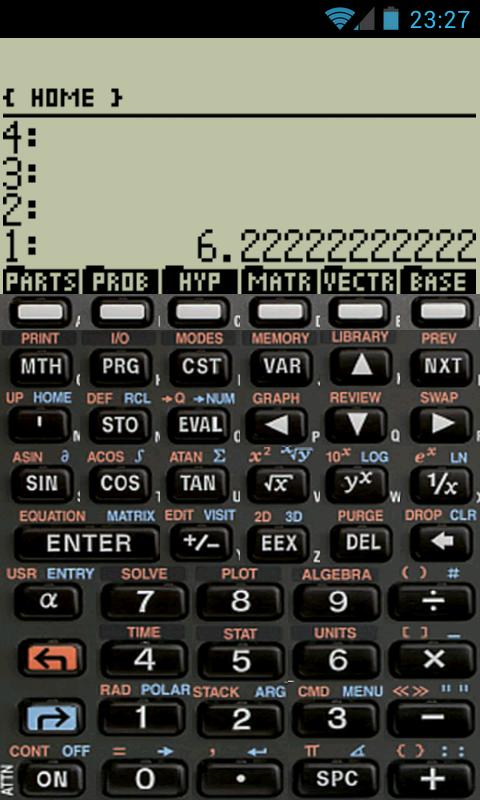
My (free) recommendations for iOS: i48 ( two different views) and Graphix48 (right).
i48 screenshoti48 screenshot 2


My (free) recommendations for Android: Droid48 (left) came first. Droid48sx (right) is a beautiful follow-on product.


go48g is a really sweet alternative to Droid48. And if you're an HP-41 fan, go41c is a beautiful (and free!) HP-41 emulator.


On iOS, youcan also buy i41cx, an HP-41CX emulator.


Once you've made the leap from free calculators to ones you actually spend money on, your whole world opens up. You can get expandable versions of the HP48 and HP41 series. You can get the HP-12c and all of its sideways brethren. And you can get my personal favorite, possibly the best overall scientific calculator HP ever made, the HP-42S. What? You've never heard of the 42S? Well, that's another story for another time.

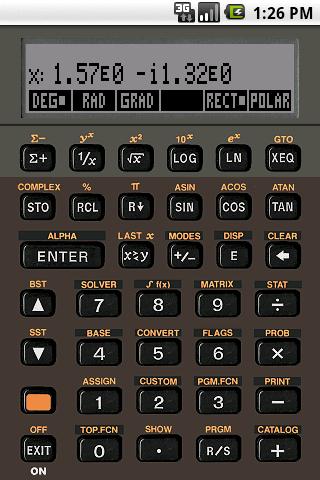
Wait! Don't spend your money yet! Here's an open-source version of the HP-42S emulator! It doesn't use a single bit of HP's ROM images; it merely duplicates the functionality. (Merely? That's a lot of mere.) For iOS (left) and Android (right).

 Free42 - screenshot

Free42 is also available for Windows, Mac, and Linux operating systems.


A note about those "key players": The HPers who released all of this code into the wild were not the movers and shakers at the top, who nearly drove this once-great company into the ground. They were a tiny number of HP engineers and engineering managers with a combination of passion, integrity and vision that is seldom seen inside HP anymore. I don't know whether they did it with the executive suite's blessing or not, but either way it was a bold move on the part of the engineers and the engineering managers, for which we thank them.

Thursday, August 23, 2012

Your smartphone is using you

I've always enjoyed reading what William H. Davidow has to say about anything. He's an intelligent guy, with a broad range of both interests and knowledge, and when he feels passionate enough about something to write about it, his words are definitely worth reading.

And when he writes about how technology — more specifically, computing technology — is taking over our lives and our brains, it's worth sitting up and paying attention to what he has to say. In the article, "Our Tools Are Using Us" (the online title is different, but I like the original title better), he points out that computing and communications technology has evolved faster than the human brain's ability to handle it  —  that is, the brain's ability to control it or to manage it. The end result is that it is controlling us instead.  As Davidow puts it, "The tools are making the rules."

If you were led to this blog entry by an alert in your mailbox, a news item in your Facebook account, or any kind of beep from your iPad or smartphone, you are caught in the trap. And if you found this article because you were on the Web during business hours, and you're still reading it, you are also caught in the trap. I mean, I'm glad you're reading this, but consider the control that technology has over you. You may think that you chose to read this, but, in a frighteningly real sense, technology made you read it.

(And the fact that I'm even typing this right now, and putting a pointer to it on Facebook, reveals that I'm also caught in the trap.)

One of the concerns about this technology trap is that it is ruining the face-to-face social interactions that are the threads that (used to) hold society together. For one example, I think of the high school athletic events that are so different today because, instead of focusing on the action on the field or chatting with fellow spectators, all of those soccer moms (and dads, and siblings, and friends) have their heads bent down and are working their smartphones through mittened hands.

Davidow cites John M. Staudenmaier, a scholar who once observed that "the quickest way to end a deep and meaningful conversation was to glance at your watch." That was in the days before smartphones. What would he say now, when personal, human-to-human contacts are similarly devalued by a beep or a buzz from our iPhones and Androids?

It took a long time to train my family that they didn't have to answer the telephone in the kitchen every time it rang. Now we need to train ourselves that we don't have to jump to our smartphone, iPad, or computer every time it calls for us. We are not Pavlov's dogs.

One of the best ways to tell someone, without words, that they matter to you is to ignore your ringing or buzzing cellphone when you're having a conversation with them. What a powerful message that sends to the person sitting there in front of you!

The other major concern about the technology trap is what it does to you, yourself. People used to have hobbies: working on cars, fly tying, model railroading, woodworking, boatbuilding, sewing, knitting, pottery, scrapbooking, photography, leatherwork, stamp collecting, and on and on. Now instead, they find something to do on their monster-sized, 1080i, HDMI television screens, and they fiddle with their smartphones or laptop computers at the same time. You know you do. Technology has captured you and enslaved you.

Even the cleansing and healing power of the mountains is ruined by these devices. The summits of Colorado's fourteeners are now polluted by remarks like "Wow! I have four bars up here!" and the ritual "Hi.... We made it.... Yeah, I'm at the top." And the sounds of nature on the hiking trails are drowned out by the music that leaks out through too-loud headphones.

Remember that some of the surest signs of an alcoholic are remarks like:
"I'm not addicted to alcohol. I can take it or leave it."
"I can stop drinking anytime I want."
If you have said anything like this about your electronic gadgets or about Facebook or (shudder) Blogger, either aloud or to yourself, then admit it. You are, to some degree, addicted to technology.

You need to give yourself the same consideration, when you're all alone, that you would give to your conversational partner in that paragraph above. Here's how Davidow does it:

I have shut off most alerts and reminders on my computer and smartphone. I check for e-mail on my own schedule, just a few times a day. At home, I have built a physical wall around the virtual world. I let myself read news on my iPad anywhere in my home, but I answer e-mails and conduct business only in my office. I heed Staudenmaier’s advice and never end important conversations by glancing at my smartphone. My iPhone is never ­present when I am out with my wife, listening to the challenges my kids are facing, or playing and laughing with my grandchildren.
Personally, there are times when I take my phone out of my pocket and leave it in the car or in another room, so that I don't have to serve it when it beckons. There's a special place I go to, in the south end of Denver, where I even choose to take off my wristwatch and put it in a locker, so that I can forget about time and concentrate on eternity for a while.

I close with Davidow's own parting shot:

My advice to you is to take control of your tools. I promise your life will be better if you aren’t constantly checking to see if you’ve got mail.

Monday, February 6, 2012

Is anything NOT made in China?

I intend to research this for myself, but I thought I'd ask here first.

Recent news articles have exposed the terrible, sometimes fatal, working conditions imposed on workers who assemble Apple's iPhones and iPads in China. These articles have implicated Foxconn and many other Apple contractors in China, who pay their workers horribly, force them to endure long hours working in dangerous and unhealthy conditions, and more or less treat them as disposable supplies, like paper towels.

Apple has yet to respond in a way acceptable to socially conscious consumers; however, Apple's products have enough going for them that consumers are still buying them. That may change, if Apple does not quickly show some sense of social responsibility.  You read it here first, folks. But that's not the main thrust of this article.

Apple is not the only company to find itself in this predicament, with a popular and competitively priced product line, completely dependent on China for its manufacture. As I have said before, you cannot buy a small kitchen appliance right now that is not made in China. After this weekend, I will add that you cannot buy a men's suit for under $500.00 that is not made in China. Can you buy a flat-screen television that is not made in China? How about a smartphone?

Let's focus on smartphones for a minute. The largest (and maybe the only) viable competitor to the iOS smartphone right now is the Android smartphone. Two of the largest makers of Android-based smartphones are Samsung and LG, followed by Motorola, HTC, and the rest of the gang. Here's a serious question: Which Android-based smartphones are NOT made in China?


Samsung and LG are Korean labels. A South Korean businessman recently told me that iPhones make up 26% of the South Korean smartphone market, while Android phones make up the other 74%, with the  majority of those Android phones being Samsung. Are Samsung smartphones made in Korea? What about LG smartphones? Searching for the word "China" in their Wikipedia entries comes up with zero.

(Another big unanswered question: Can we assume correctly that working conditions in Korea are better than they are in China?)

And what about Nokia? Well, Nokia is a Finnish label.  That's right, one of the most reliable names in the cellular phone business is headquartered in the tiny (but very advanced!) country of Finland. According to Wikipedia, two of Nokia's nine manufacturing facilities are in China. But Nokia phones don't run Android. They still run Symbian, though some ran Linux for a bit and they're all slated to run MS Phone 7 starting in late 2011.

One of Nokia's subsidiaries is a relatively unknown company called Vertu. Vertu makes "luxury" smartphones by hand, out of the finest materials, in its factory in England. The screen is a thin sheet of clear, transparent, single-crystal sapphire. Each key is individually machined from a chunk of sapphire. All of the apps are custom-written, and they run on Symbian. Okay, so this one counts as "not made in China," but you won't find very many Vertu phones on the street. They start at about US$5000.

Does that leave Samsung and LG as the only smartphone choices for the socially responsible consumer? (And, as it turns out, for the environmentally responsible consumer - both manufacturers have been recognized for their environment-friendly practices.)

LET'S BROADEN THE DISCUSSION:  What about children's toys? Printed books? Flat-screen televisions? Stereos and home entertainment systems (even the ones with Japanese names)? Computer hardware? Dishes and cutlery? Automotive parts? Automotive accessories? Hand tools? Power tools? What can we buy today that is not made in China?

Please hit the Comment link and add to the discussion. Don't be scared off by the Captcha thingy or my comment-moderation policy. If you're not a spammer or a Net loon, your comment will be posted within a few hours.