Showing posts with label ipod. Show all posts

Monday, October 28, 2013

HP calculators live on, small thanks to HP

UPDATE, 22 JAN 2024:

The Desmos product line continues to expand. Remember, these are all free apps. Their current offerings include:
The Desmos 3D calculator is an exciting new product! As of this update, the 3D calculator is still in Beta. But it is as intuitive as their original offerings. I typed in three equations: x = cos theta, y = sin theta, and z = theta, and the calculator plotted a nice spiral surface for me. No RTFM necessary. It just works!

Thomas Okken, the creator of Free42, has added another project to his page. Plus42 is an enhanced version of Free42. It's a paid app on Android and iOS, but is free for Mac, Windows, and Linux PCs. Please support his efforts by giving him money, one way or another.

The SwissMicros DM42, which runs Free42, is still being built and sold, and actively supported, and getting rave reviews online. I still want one.

In fact, the hardware and OS of the DM42 are so good, that it has proven to be infinitely customizable. The DM42 hardware serves as the host platform for other, new, open source calculators, such as the WP43, the C47, and the DB48X (yes, that's a "48"). These developments may deserve their own super-nerdy blog entry here on Zyzmog Galactic HQ. At the very least, in lieu of that blog entry, click on the links above and read about them for yourself.

The HP-12C (the Calculator that Refuses To Die) is still selling. Wikipedia calls it "HP's longest and best-selling product." HP has upgraded the HP-12C's innards several times now, so it keeps getting better and better. Other than the 12C, HP's calculator line is basically defunct.

TI continues to sell their ancient and overpriced TI-84 series to a captive market, but I think that their influence is finally waning, thanks to Desmos and others. TI doesn't appear to be pouring any more software engineering effort into improving their cash cow / golden goose. Let us wish TI a speedy march into oblivion.


UPDATE, 18 JUL 2022:

This is still one of the most widely read articles on my blog. That's gratifying. I'm glad to see that it is so useful to so many people.

The SwissMicros version of the HP42 drifts in and out of stock, as do the rest of the SwissMicros calculator product line. Don't let that worry you. It's merely a sign of the craftsmanship with which these beauties are built. (p.s. I want one.)

The Desmos calculators continue to march ahead. More power to them, I say, and to Eli Luberoff and his company. I hope that they make tons of money. Don't worry; their calculators are still free to you, and always will be.

And a final bit of good news: Free42 is not only alive and kicking after 15 years, but it is thriving! It is still in active development. The latest version was released a little over a month ago, in February 2020. If you have followed my recommendation and downloaded this little jewel, consider helping out by clicking on the Donate link on the Free42 webpage and sending Thomas a little cash.

UPDATE, 3 OCT 2019:

There's a Swiss company, SwissMicros, which makes absolutely beautiful replicas of some of the greatest HP calculators: the 10, 11, 12, 15, 16, 41, and 42. Yes, the 42.

There's a new game in town, and it makes the HP and TI calculators as obsolete as dinosaurs. Read this blog article about Desmos.

UPDATE, 27 SEP 2019:

This is one of the most widely read articles on my blog. It's good information. Since Apple did some housekeeping on their App Store, some of the picture links are broken. I've replaced them with local pictures.

In addition, Graphix48 has disappeared from the App Store. I wish I'd saved a local picture of it, because it was good. The developer's web page has also disappeared.

NOW, FOR THE ORIGINAL ARTICLE, 28 OCTOBER 2013:

The first pocket-sized scientific calculator in the world was the HP-35, invented by Hewlett Packard and introduced to the world in 1972. HP literally created the market for handheld scientific calculators. Although many worthy competitors arose, none could match HP's quality, reliability and overall superior design. HP was king of the mountain until Carly Fiorina chose to pull the plug on the calculator division sometime in the 1990s around 1999, and ceded the entire market to Texas Instruments.

Carly's excuse at the time was that "calculators are not profitable," which was an outright lie. We won't get into that here. That's water under the bridge. The geniuses who invented such dominant creatures as the HP-12C (the financial calculator that refuses to die), the HP-41 series and the HP-48 series, have moved on to other careers. So has Carly. Around HP, some people still spit after they say her name.

HP calculators have a vast and loyal fan base around the world. Some of those fans were later hired by HP to revive the calculator division, but it was too little, too late, and HP has never reclaimed the market. Like I said, that's a topic for another time, and besides, whining about it won't bring back the glory days.

One of the wisest things HP did, after announcing the dissolution of their calculator division, was release their ROMs into the wild. You can find ROM images, and maybe even source code, for many of HP's calculators online. I believe you can even find source code and emulators for the Saturn and other 4-bit CPUs at the heart of the calculators. (No, I won't include links. Go sniffing for them if you want them.)

Thanks to this wise and generous move by some key players inside HP (see the note at the end), their calculators live on. You can now have an HP calculator app on your iOS or Android device. These emulators work as well as the real things, including support for external storage and printers (on some apps).

My (free) recommendations for iOS: i48 ( two different views) and Graphix48 (right).
i48 screenshoti48 screenshot 2


My (free) recommendations for Android: Droid48 (left) came first. Droid48sx (right) is a beautiful follow-on product.

go48g is a really sweet alternative to Droid48. And if you're an HP-41 fan, go41c is a beautiful (and free!) HP-41 emulator.


On iOS, youcan also buy i41cx, an HP-41CX emulator.


Once you've made the leap from free calculators to ones you actually spend money on, your whole world opens up. You can get expandable versions of the HP48 and HP41 series. You can get the HP-12c and all of its sideways brethren. And you can get my personal favorite, possibly the best overall scientific calculator HP ever made, the HP-42S. What? You've never heard of the 42S? Well, that's another story for another time.

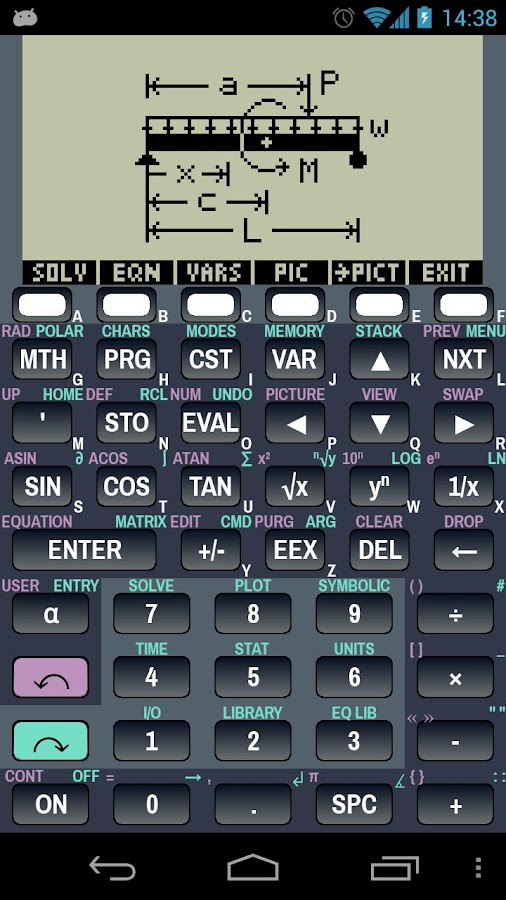
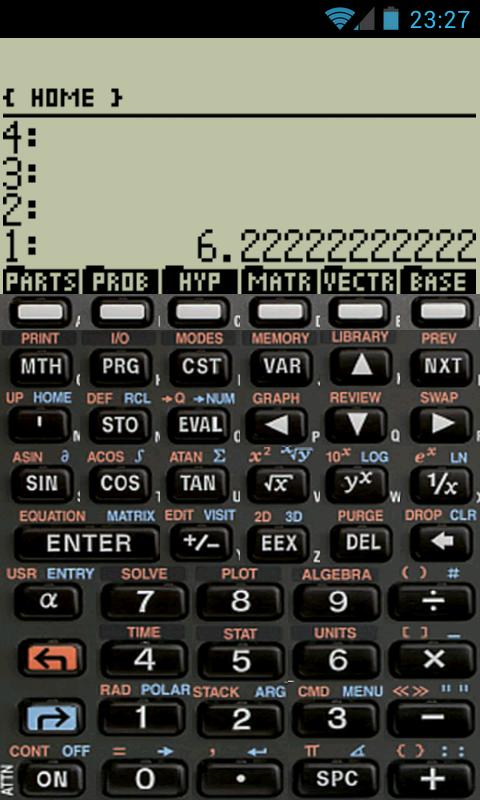
Wait! Don't spend your money yet! Here's an open-source version of the HP-42S emulator! It doesn't use a single bit of HP's ROM images; it merely duplicates the functionality. (Merely? That's a lot of mere.) For iOS (left) and Android (right).

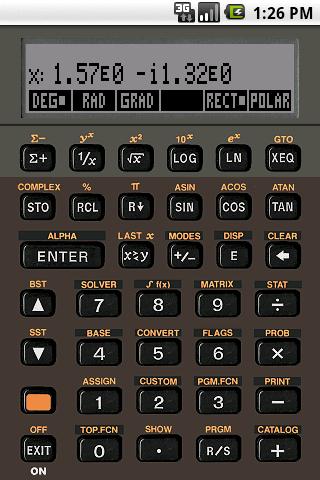
 Free42 - screenshot

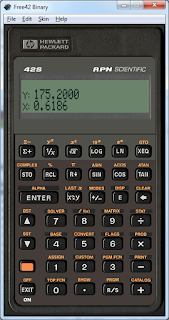
Free42 is also available for Windows, Mac, and Linux operating systems.


A note about those "key players": The HPers who released all of this code into the wild were not the movers and shakers at the top, who nearly drove this once-great company into the ground. They were a tiny number of HP engineers and engineering managers with a combination of passion, integrity and vision that is seldom seen inside HP anymore. I don't know whether they did it with the executive suite's blessing or not, but either way it was a bold move on the part of the engineers and the engineering managers, for which we thank them.

Monday, February 6, 2012

Is anything NOT made in China?

I intend to research this for myself, but I thought I'd ask here first.

Recent news articles have exposed the terrible, sometimes fatal, working conditions imposed on workers who assemble Apple's iPhones and iPads in China. These articles have implicated Foxconn and many other Apple contractors in China, who pay their workers horribly, force them to endure long hours working in dangerous and unhealthy conditions, and more or less treat them as disposable supplies, like paper towels.

Apple has yet to respond in a way acceptable to socially conscious consumers; however, Apple's products have enough going for them that consumers are still buying them. That may change, if Apple does not quickly show some sense of social responsibility.  You read it here first, folks. But that's not the main thrust of this article.

Apple is not the only company to find itself in this predicament, with a popular and competitively priced product line, completely dependent on China for its manufacture. As I have said before, you cannot buy a small kitchen appliance right now that is not made in China. After this weekend, I will add that you cannot buy a men's suit for under $500.00 that is not made in China. Can you buy a flat-screen television that is not made in China? How about a smartphone?

Let's focus on smartphones for a minute. The largest (and maybe the only) viable competitor to the iOS smartphone right now is the Android smartphone. Two of the largest makers of Android-based smartphones are Samsung and LG, followed by Motorola, HTC, and the rest of the gang. Here's a serious question: Which Android-based smartphones are NOT made in China?


Samsung and LG are Korean labels. A South Korean businessman recently told me that iPhones make up 26% of the South Korean smartphone market, while Android phones make up the other 74%, with the  majority of those Android phones being Samsung. Are Samsung smartphones made in Korea? What about LG smartphones? Searching for the word "China" in their Wikipedia entries comes up with zero.

(Another big unanswered question: Can we assume correctly that working conditions in Korea are better than they are in China?)

And what about Nokia? Well, Nokia is a Finnish label.  That's right, one of the most reliable names in the cellular phone business is headquartered in the tiny (but very advanced!) country of Finland. According to Wikipedia, two of Nokia's nine manufacturing facilities are in China. But Nokia phones don't run Android. They still run Symbian, though some ran Linux for a bit and they're all slated to run MS Phone 7 starting in late 2011.

One of Nokia's subsidiaries is a relatively unknown company called Vertu. Vertu makes "luxury" smartphones by hand, out of the finest materials, in its factory in England. The screen is a thin sheet of clear, transparent, single-crystal sapphire. Each key is individually machined from a chunk of sapphire. All of the apps are custom-written, and they run on Symbian. Okay, so this one counts as "not made in China," but you won't find very many Vertu phones on the street. They start at about US$5000.

Does that leave Samsung and LG as the only smartphone choices for the socially responsible consumer? (And, as it turns out, for the environmentally responsible consumer - both manufacturers have been recognized for their environment-friendly practices.)

LET'S BROADEN THE DISCUSSION:  What about children's toys? Printed books? Flat-screen televisions? Stereos and home entertainment systems (even the ones with Japanese names)? Computer hardware? Dishes and cutlery? Automotive parts? Automotive accessories? Hand tools? Power tools? What can we buy today that is not made in China?

Please hit the Comment link and add to the discussion. Don't be scared off by the Captcha thingy or my comment-moderation policy. If you're not a spammer or a Net loon, your comment will be posted within a few hours.

Thursday, October 6, 2011

In Honor of Steve Jobs

Better writers than me have written better eulogies than this for Steve Jobs in the past 24 hours. I recommend the ones at Wired and NPR. I'm sure Time will have something worthwhile to read. Since I don't have anything new or exclusive to add, this entry will be short.

Steve Jobs died of pancreatic cancer on Wednesday, October 5, 2011. He was 56 years old. He left behind a wife and four children, whom he loved and whom he carefully kept out of the spotlight during his very public career. He also left behind a vibrant computer company, one that in its own way (and in his own way) defined consumer computing, leading the way for Microsoft and IBM, and later for Google, Motorola and all the other "me-too" companies.

What did he do?  Well, an automobile is a complex piece of machinery, and yet every single automobile in the world is controlled in exactly the same way, with a steering wheel, a gear shift, and two pedals.  Jobs did the same thing for computers and computing.  Outside of what he has left for his family, that may be his greatest legacy.

With the iPhone, he also reinvented the mobile telephone.  And with Pixar, he reinvented animated, feature-length, family movies.

 He is named as inventor or co-inventor on over 300 patents, covering computers, telephones, music, and more.  Steven Levy, in his eulogy in Wired, named Jobs' six biggest technical and business accomplishments:
  • the Apple II computer
  • the Macintosh computer
  • Pixar Studios
  • the iPod
  • the iPhone
  • the iPad
In the NPR story, Robert McNamee, a venture capitalist, called Jobs a modern-day "Thomas Edison."  Moviemaker Steven Spielberg (what is it with all these Stevens today?) echoed that sentiment.

Whether you own an Apple product or not, Steve Jobs has had a profound and lasting effect on your life.

Edit:  I added the picture.  Not sure what the original source was; I swiped it from FB.

Friday, September 16, 2011

The new bubble: China

In the wake of the dotcom bubble of 1995-2000, and the real-estate-bubble catastrophe of 2003-2008, economists and policymakers are looking around anxiously, trying to predict the next bubble to burst.  In all their casting about, they are quietly ignoring the dead moose lying right there on the coffee table in the middle of the room:  China.

Consider the dotcom bubble for a minute.  The bubble was caused by a bunch of entrepreneurs who jumped on the make-money-fast-on-the-Internet bandwagon (the ".com" suffix, pronounced "dot-com," became a new word and a label for the whole fiasco), and all the investors who fed them money.  Greed fueled the dotcom bubble.  Even people who should have known better, smart and educated Wall Street professionals, bought into the boom.  Some college professors and very conservative investment advisors warned that both the entrepreneurs and the speculators were ignoring the basic principles of investing, but others said that the dotcom boom had rewritten the rules.  I actually heard several "experts" on public radio saying, "This time it's different."

Well, that time, it was no different.  Most of the dotcom businesses  went bankrupt in a few years.  The entrepreneurs and the investors lost everything.  The money simply disappeared, along with everything built on that money.

When you get right down to it, the cause of the dotcom bubble was pure and simple greed:  people wanted to get rich quick.

The real estate bubble was the same way:  Before the bubble began, mortgage lending was governed by strict rules.  A potential homebuyer had to have a large enough down payment to indicate a serious intent to keep the property, and a demonstrated ability to make the required monthly payments.  Potential lenders did serious evaluations of buyers' ability to pay:  the credit appraisal.  Millions of homebuyers have experienced the anxious waiting period while their credit appraisal was being completed, wondering what kind of credit risk the lender would assess them at, and what mortgage terms they would be offered as a result.

Suddenly, almost overnight, the lending rules changed.  The required down payment dropped from 20 percent, to 10 percent, then five percent, and finally zero percent.  No down payment was required to get into a house.  At the same time, credit terms were relaxed.  There was no longer any need to demonstrate that a buyer could sustain a mortgage payment - not for one month, let alone for 30 years.  And finally, an insidious form of mortgage which had been quietly gaining in popularity for 30 years seemed to take over the market.  This was the negative-amortization loan, which allowed a buyer to make smaller payments than the minimum required by the traditional formulas, with the accrued interest being added to the principal, so that the buyer owed more and more money as time went on.  Some of these negative-amortization loans had a a schedule of gradually increasing payments as the years went on.  Some only had a term of three to five years, with a huge "balloon" payment at the end, with the unwritten (but oft-spoken) mutual expectation that the buyer would arrange new and better financing before the loan expired.

Two things happened as a result of this relaxation of the rules.  First, people who should never have been buying houses started buying houses.  Second, everybody - well, almost everybody - started buying houses bigger than they could afford.  Then sellers started realizing that they could get a lot more money for their property than they were expecting, and so they started jacking up the prices of their homes.  Home prices had been rising steadily for decades anyway, but suddenly the prices accelerated their upward trend.

Everybody was getting rich.  Buyers were getting bigger houses than they could afford.  Sellers were making lots of money.  Lenders were getting lots of mortgages - meaning that they owned lots of homes.  Then the sellers, mostly banks, started bundling the mortgages together (think of the physical metaphor, all of those paper mortgage agreements, stacked up and held together with rubber bands) and selling them to each other as investment instruments.  Heck, if all those buyers actually made their payments for 30 years, those mortgages represented a lot of income for the lenders!

(We haven't even talked about China yet.  Stay tuned.)

So buyers, sellers, lenders, and stockholders saw the chance to get really rich, really quick, and they jumped on it.  Once again, as with the dotcom bubble, people ignored the safe and sensible rules of investing, caught up in the chance to make money off the rapid rise in property values.  Builders built, banks lended, flippers flipped, and real estate agents (and their friends, the mortgage brokers) paid cash for fancy new cars and stuff.  As before, greed ruled the day.

This entire house of cards was built on a foundation of borrowers - home buyers - who couldn't afford to pay back the money they had borrowed.  When these people eventually ran out of money and defaulted on their loans, the lenders exercised the terms of the mortgage, kicked them out of their homes, and took over their property.  But foreclosed property doesn't make the banks any money.  They try to get rid of it as quickly as they can.  But the banks had acquired so many homes that they couldn't sell them all - not quickly, not slowly, and not for anywhere near their appraised value.  That's because the home values had been horrendously inflated in the price runup that was the bubble.

Now the banks had the properties, but not the cash flow that the properties were supposed to generate.  Without money coming in, the banks couldn't take care of their own financial obligations.  So the banks started failing, or at least were in danger of failing.  The only way they could generate money in a hurry was by selling some of their investments.  And the vast majority of investments were those bundles of mortgages - "mortgage-backed securities," they were called - and since those mortgages were in default, they were worthless pieces of paper.  Nobody wanted to buy them.

So the homeowners lost their homes, the banks lost their money, and the investors lost their money.  Banks couldn't afford to pay their bills or their employees.  All the money that went into the real estate market disappeared and was gone forever.  The ripple effects from this disaster led to failures in other, tightly connected industries, such as investment broker Merrill Lynch, insurance company AIG, and automaker General Motors. That's when all the banks, the investment companies, the insurance companies, and the automakers ran crying to the government, saying "we're too big to fail."

In case you haven't figured it out yet, I'll say it again.  The entire dotcom bubble and bust was caused by greed.  The entire real estate bubble and bust was caused by greed.

And that brings us to China.  I speak of China here as one monolithic entity, encompassing its government, its financial institutions,  and its industries.  Some of you may object if I include Taiwan and Hong Kong in the monolith, but for now that's what I'm doing.  I may lump the Chinese people in here as well, because the individuals are what make up the aforementioned institutions.

China is the next big bubble, and when it busts, the results will be a worldwide catastrophe.  And as with the dotcom and real estate bubbles, the driving force behind it all is greed.

China has systematically undercut prices for manufactured goods all over the world.  Because of the low prices offered by Chinese manufacturers, many American companies have moved all their manufacturing from North America to China.  It saves the American companies lots of money, which shows up in their  corporate profits.  Besides, it lets them sell their goods to American consumers more cheaply, and American consumers like "cheap."  Most American consumers prefer "cheap" over "quality," but I don't think we'll get into that here.

As a result, most, if not all, of the American companies who make their goods in China are trapped.  For example, all of Apple's iPads and iPhones are made in China.  They could not stay in that business segment if they were suddenly forced to make them here.  Even if they could set up an assembly line, they couldn't run it without the components - the display, the batteries, and so on - because the components are also made in China.

(There was a great article in Forbes recently, called "Why Amazon Can't Make a Kindle in the USA.")

Much of today's high-tech gadgetry, including the cheapest cellular phone on the market, depends on some exotic minerals known as rare earth elements to operate.  Those rare earths used to be mined in Africa, Russia, and North and South America.  Several years ago, China started mining them and selling them at drastically reduced prices.  The other mines could not compete and shut down, leaving China as the sole source for these rare earths.  Recently, China has been talking about jacking up the price or restricting the supply of these minerals.  Guess what would happen to Nokia and other (non-Chinese) cellphone manufacturers if rare earths became too expensive to buy, or simply unavailable?  That's right!

Recently, I wanted to buy my wife a new kitchen mixer.  I went to three department stores here in the western U.S.  Every single mixer I looked at was made in China.  The venerable domestic brands like Sunbeam, and the classy European brands like, um, Braun (I think) all had "Made in China" stamped on the box somewhere.  And they were all made in China because it's cheaper.

Our first vacuum cleaner was a Hoover.  It was made in America (or Canada, I think) and it was mostly made of metal.  Our second vacuum cleaner was also a Hoover.  It was mostly made of plastic, but it was still made in America.  Together, those two vacuum cleaners lasted over 30 years.  They were sturdy machines, and we used them A LOT.  Now we're shopping for our third vacuum cleaner.  We looked at the offerings from Hoover.  They're made mostly of plastic.  They're made in China.  They have a terrible reputation for workmanship, reliability, and vacuum-ability.  Why should we buy Hoover again?  We won't.

Hoover's not the worst, nor is it the cheapest.  There are cheaper vacuum cleaners.  They don't work very well, either.  And guess where every single one of them is made?

It gets worse.  Shall we look at automobiles?  The concept of a "made in America" automobile, even a manly American pickup truck, is laughable.  All of the electronics are made in China, or assembled in the U.S. (or Mexico or another country) from components made in China.  The bumpers and fenders may be made in the U.S. (or Mexico or Ohio), but the raw materials for those metal bumpers and plastic fenders were shipped to the U.S. from overseas - mostly from China!  Even the fabric or vinyl upholstery for the seats comes from China.  The light bulbs!  The floor mats!  Detroit has outsourced all of it, in an effort to make a buck.

(John Deere, in Iowa, still makes a lot of their own components.  But Chinese electronics are starting to make inroads there, even.)

How did the U.S. government finance the bailout of the companies that got caught in the 2008 financial crisis following the bust of the real estate bubble (especially the "too big to fail" companies that should have been allowed to fail, or else cut up into smaller pieces that were no longer "too big to fail")?  They sold government-backed securities to other countries.  And which country bought the lion's share of those securities?  Which country was so flush with cash (or the promise thereof - remember how the real estate bubble worked!) that it could step in and buy billions of dollars of U.S. treasury bonds without flinching?  Well, China, of course!

And guess where China got all that money from?  From America, of course!  They sell us their stuff, they collect our money, and then they buy our country and our future.

But it's all a house of cards, just like the dotcoms and the housing boom.  China has looked into their future and they're forecasting massive growth - so massive that they've gone out into the countryside and carved out entire cities from nothing.  Street lights, apartment buildings, government buildings and shopping centers have risen out of the pastures and are waiting for people to move into them.  These "ghost cities" can be seen on Google Maps, and they're eerily empty.  The Chinese are mining coal and burning it at a furious rate, to literally fuel their growth.  They are damming rivers and gouging out strip mines to supply their hungry industries with raw materials.

And they are engaging in a centuries-long tradition of imitation and deception.  They take products made in the West, try to figure out what makes them work, and then try to come up with a copy that looks the same - right down to the trademarks, the colors and the textures.  Some of the patented and trademarked cable that my own employer makes has appeared in counterfeit form in Asia - made in China.

In the ultimate irony, they duplicate not only Apple's computers and handheld products (and remember, the legitimate ones are also made in China), but they sell them in 22 imitation Apple stores.  The stores are not affiliated with Apple Computer in any way, but their layout, decor, and even employee uniforms and name badges are exact duplicates of what you will find in real Apple stores.  The deception is so complete that some of the store employees think they are really working for Apple Computer.

I have already written about the sham (and the scam) that was the 2008 Beijing Olympics.  It was a plastic imitation of the real thing, a shameless ripoff of other people's hard work, enabled by the duplicity of the Chinese government and the gullibility of the rest of the world.  In the same way, the duplicity of monolithic China and the willingness of the rest of the world to be led around by the nose (or other body parts) has contributed to the growth of the house of cards that is the Chinese bubble.

Actually, that's not completely accurate.  At the core of everything, it is the greed of monolithic China and the greed of the rest of the world that have contributed to the Chinese bubble.

One day, the U.S. government or another government will not be able to make good on the financial instruments that China holds.  China will find out that it is holding on to worthless pieces of paper, and that China does not have enough real money to keep operating.  With no money to pay its own obligations, power plants and mines will shut down.  Trains will stop operating.  With no way to get raw materials, factories will shut down and send their workers home.  With no jobs and no money to spend, Chinese people will stop buying their own goods.  With nothing to ship, ships will stop crossing the ocean, and Americans will no longer be able to buy Hoover vacuum cleaners, Sunbeam mixers, or Apple iPhones.  Without the raw materials and components from China, American automakers (and Japanese and German ones, too) will no longer be able to build cars.

Printing presses, computers, traffic lights, tables, chairs, dishes, cutlery, light bulbs, furniture, clothing:  all of it will come to a stop until alternative sources can be found or tooled up.  Those alternative mines and factories will spring up all over the world, but they won't start producing overnight.  They will take years.  And the wealth, or commerce, or economic prosperity - the money - that was lost forever will take even more years to replace.

It may take a decade for the bubble to burst.  Some people will argue with me and say it will never happen.  But it ony took 15 years for the gigantic Japanese economic machine, which was also supposed to take over the world, to come crashing down.  It surely did, and the Chinese one will come crashing down just as surely.  And when it does, it will take years for the world to recover.

From its own greed.

Monday, November 1, 2010

Looking for iPod touch 4G accessories

I need your help finding some stuff for an iPod touch 4G.

I've done research all over the Web, and it's overrun by marketing hype, biased reviews (you know, shills), and advertising. I've looked in the local stores, and the selection is limited and overpriced. I figured I'd ask for help from my loyal readers.

I got a fourth-generation iPod touch as a gift, and I've already got scratches on the metal case. Eventually I'm going to scratch the glass front, or simply drop the thing, and that would be bad. I need to buy some protection for it.

What have you had experience with, and what would you recommend? Specifically, I'm looking for recommendations on:
  • screen protector
  • hard-shell or soft-shell case
  • armband-style carrying pouch
While I'm thinking about it, I must say a word or two about apps. The first word is disappointing. The second word is wasteland, as in "Wow, what a wasteland." The current state of Apple's App Store is like the early days of the Mac, and the early days of the World Wide Web: there's a lot of content out there, and 95% of it is garbage. I'd estimate that 95% of what's at the App Store is poorly written, poorly debugged, and only marginally useful / relevant / practical. There's not a lot to differentiate a good app from a bad one: the reviews vary so widely as to call the credibility of all of them into question; and you can't even use purchase price as a reliable differentiator.

(I'll be adding to the wasteland, creating some apps for my employer.)

As for the music, well, I'm joining the revolution late, but not too late. I've finally become sold on digital / downloaded music. Among the massive contemporary offerings, I found some obscure gems. I found Aerie, an early John Denver album, formerly only available on CD as a horrendously overpriced import (if at all), now available at high quality and costing almost the same as it did back in nineteen-seventy-mumble. I also found Greatest Highs, a giant compilation album from the Kottonmouth Kings, a hip-hop group who specialize in raunchy (and mostly inappropriate) lyrics extolling weed and other stuff that I probably shouldn't be thinking about.

Yeah. So please, give me your recommendations for screen covers, cases, and exercise pouches. As always, your comments go through a moderation/approval screen, but unless they're an obvious sales job, they'll be approved instantly.

(I can't wait to see what AdSense offers up with this posting!)