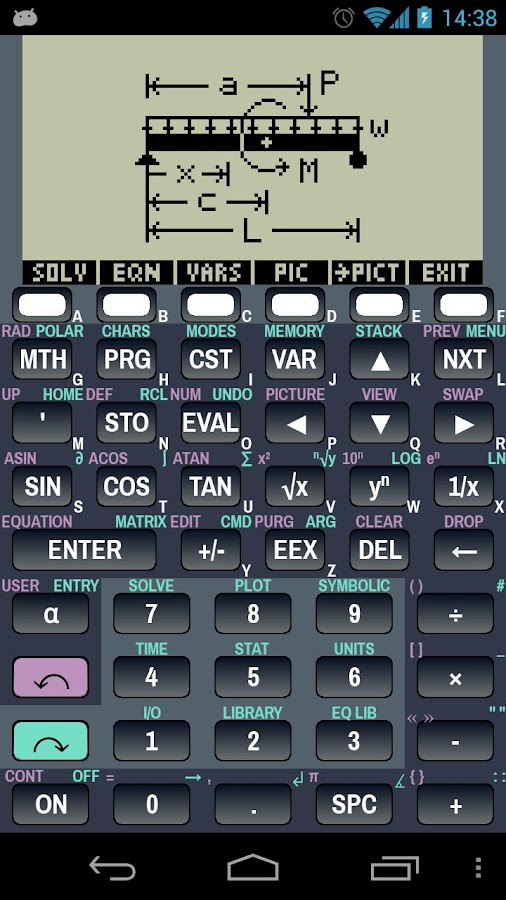
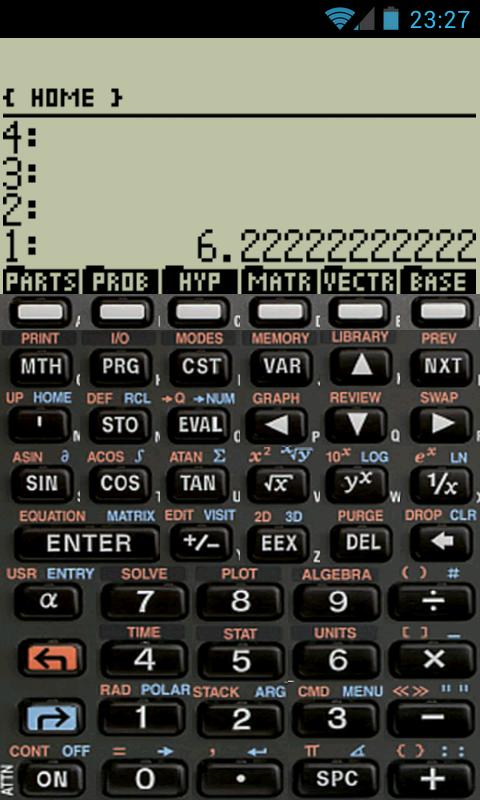
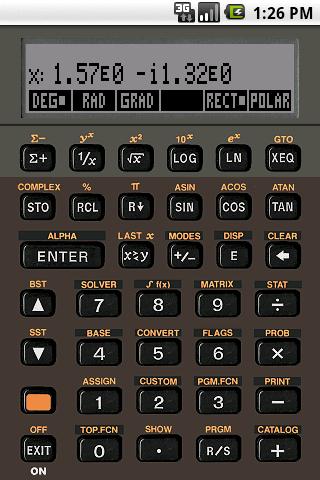
A recent article in The Hustle revealed how, after HP slunk away, TI took steps to completely take over the calculator market, lobbied to make TI calculators required items in middle and high school math classes, and, having established a monopoly, jacked up prices on them and made obscene profits.
But the article also points to a new calculator family that may make TI handhelds go the way of ... well, HP handhelds. (And good riddance to them — the TI ones, that is. I always thought the TI devices were products of superior marketing, not superior engineering.)
In May 2011, a company called Desmos announced that they were going to create a new graphing calculator, and it would be implemented as an iOS app and an Android app. Not many years later, they did it — they released a graphing calculator, better than the HP and TI handhelds that had preceded it.
Then they released a powerful scientific calculator sans graphiques, also an improvement on its HP and TI antecedents.
And they released a "test mode" calculator, one that would comply with calculator restrictions on standardized tests.
Because the apps were written in Javascript, it was easy to turn them into web-based apps as well, so you can access them in any web browser.
Desmos has a unique business model. They intend to make money on these apps, but not from the end user. By offering the apps for free to end users, Desmos eliminates the inequity that arose as TI kept raising the prices on their hardware to the point that poorer math students could no longer afford them. Desmos makes money from the textbook publishers and curriculum designers, through very attractive licensing terms.
These calculators are easy to use. When I downloaded the graphing calculator, I didn't even need to watch a video or read a Getting Started guide - I just started punching away, and I had dynamite results in no time. The user interface is clean and uncluttered, and it's almost as intuitive as a wooden pencil. It's also very modest, the only self-promotion being a "powered by desmos" watermark, which is hidden behind the keyboard.
Users have found ways to make some fascinating vector graphics (that means "pictures") on the graphing calculators as well. See the examples near the end of this article.
So feel free to download a Desmos calculator. Enjoy it!
Links:
Graphing calculator
- Apple app store
- Google app store
- Web app
Scientific calculator
- Apple App store
- Google app store
- Web app
Test-mode calculator
- Apple app store
- Google app store: not there yet, as of 2 Oct 2019
And a regular old four-function calculator!
- Just a web app
Screen shots:
I screen-grabbed these from the Google app store. If Desmos, Apple or Google want to yell "copyright infringment!", then I'll delete them.


Here's some of the artwork creative users have come up with.

End notes:
If you're still reading this, you're awesome.
1. I can't believe I didn't find out about Desmos earlier. They announced their intentions and started rounding up funding in May of 2011. I published my article on HP calculators in October 2011.
2. Even though the Desmos calculators are great, Free42 is still my professional go-to calculator. I have it on my phone, on my Windows PCs, and on my Linux PCs. One day, I will own the hardware version of it, the Code Made Flesh, the DM42 by SwissMicros.
3. Desmos is still growing, and their product line is still growing. See their website for other cool stuff.
4. I don't know if these are programmable calculators, but if they are, then games won't be far behind.
5. Be sure to take the batteries out of your old HP or TI calculator. It's going to be sitting in your drawer, unused, for a very long time, and you don't want the batteries to corrode and ruin it, because if that happens, you won't be able to sell it on eBay in five years when you realize you'll never need it again.
Then they released a powerful scientific calculator sans graphiques, also an improvement on its HP and TI antecedents.
And they released a "test mode" calculator, one that would comply with calculator restrictions on standardized tests.
Because the apps were written in Javascript, it was easy to turn them into web-based apps as well, so you can access them in any web browser.
Desmos has a unique business model. They intend to make money on these apps, but not from the end user. By offering the apps for free to end users, Desmos eliminates the inequity that arose as TI kept raising the prices on their hardware to the point that poorer math students could no longer afford them. Desmos makes money from the textbook publishers and curriculum designers, through very attractive licensing terms.
These calculators are easy to use. When I downloaded the graphing calculator, I didn't even need to watch a video or read a Getting Started guide - I just started punching away, and I had dynamite results in no time. The user interface is clean and uncluttered, and it's almost as intuitive as a wooden pencil. It's also very modest, the only self-promotion being a "powered by desmos" watermark, which is hidden behind the keyboard.
Users have found ways to make some fascinating vector graphics (that means "pictures") on the graphing calculators as well. See the examples near the end of this article.
So feel free to download a Desmos calculator. Enjoy it!
Links:
Graphing calculator
- Apple app store
- Google app store
- Web app
Scientific calculator
- Apple App store
- Google app store
- Web app
Test-mode calculator
- Apple app store
- Google app store: not there yet, as of 2 Oct 2019
And a regular old four-function calculator!
- Just a web app
Screen shots:
I screen-grabbed these from the Google app store. If Desmos, Apple or Google want to yell "copyright infringment!", then I'll delete them.
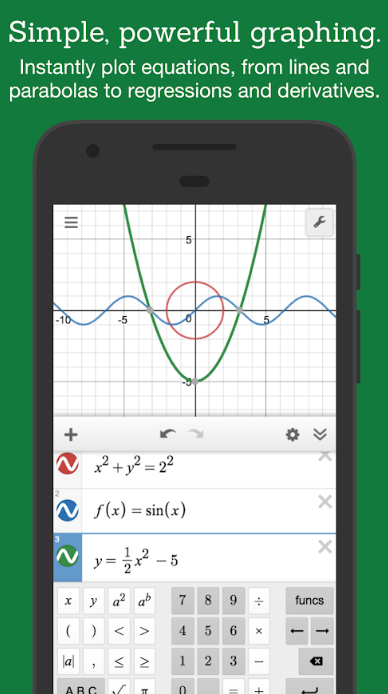


Here's some of the artwork creative users have come up with.

End notes:
If you're still reading this, you're awesome.
1. I can't believe I didn't find out about Desmos earlier. They announced their intentions and started rounding up funding in May of 2011. I published my article on HP calculators in October 2011.
2. Even though the Desmos calculators are great, Free42 is still my professional go-to calculator. I have it on my phone, on my Windows PCs, and on my Linux PCs. One day, I will own the hardware version of it, the Code Made Flesh, the DM42 by SwissMicros.
3. Desmos is still growing, and their product line is still growing. See their website for other cool stuff.
4. I don't know if these are programmable calculators, but if they are, then games won't be far behind.
5. Be sure to take the batteries out of your old HP or TI calculator. It's going to be sitting in your drawer, unused, for a very long time, and you don't want the batteries to corrode and ruin it, because if that happens, you won't be able to sell it on eBay in five years when you realize you'll never need it again.