Windows XP, arguably the best Windows OS that Microsoft ever created, is scheduled to die on April 8, 2014. Oh, the OS will continue to work just fine, but that's the date when Microsoft will stop supporting it or issuing security updates and patches for it. After April 8, if you want to use Windows XP, you're on your own.
Yet people won't stop using XP. (Remarkably, most ATMs in the world run on Windows XP, even with three weeks remaining before the end-of-support date.) Why not? Because it works.
Not only does it work, but it has proven over the years, from its inception in 2001 until now, that it is a healthy, robust, easy-to-use version of Windows. It is such a good operating system that Windows Vista was unable to unseat it in 2007. Windows 7, released in 2012, was more an apology for the bloated, sluggish, dead-out-of-the-box Vista than it was a replacement for Windows XP, and it did not surpass XP in market share until August 2012 (according to Wikipedia). The only reason Win7 got any market share from XP was that Microsoft stopped shipping XP. After June 30, 2008. if you wanted to get an XP license, you had to buy one on eBay or Amazon. The latest version of Windows, known as Windows 8, has been received almost as poorly as Vista was.
XP has proven so robust and so popular that Microsoft has had to provide "downgrade paths" and "compatibility modes" for Win7 and Win8 users who wanted to revert to XP.
Some critics, Microsoft included, will say that Win7 and Win8 have a greatly improved feature set over XP. Well, so did Vista, and nobody wanted Vista.
They will also tell you that XP is riddled with security holes - not to mention regular old bugs. Well, so is every version of Windows that has come after XP.
The Linux heads will tout the superiority of Linux over any version of Windows. That's a religious debate that I don't want to get into here. But the pervasiveness of the Windows OS, in any flavor, is undeniable. And XP is the best OS that Microsoft has come up with yet.
Note: This post was written on a Windows 7 computer.
Monday, March 17, 2014


Monday, October 28, 2013
HP calculators live on, small thanks to HP
UPDATE, 22 JAN 2024:
The Desmos product line continues to expand. Remember, these are all free apps. Their current offerings include:
- their original graphing calculator
- their original scientific calculator
- a nice little four-function calculator
- a practice page, to help you prepare to use these calculators in a test or exam
- a matrix calculator
- a clever and intuitive geometry tool
- a new 3D calculator
The Desmos 3D calculator is an exciting new product! As of this update, the 3D calculator is still in Beta. But it is as intuitive as their original offerings. I typed in three equations: x = cos theta, y = sin theta, and z = theta, and the calculator plotted a nice spiral surface for me. No RTFM necessary. It just works!
Thomas Okken, the creator of Free42, has added another project to his page. Plus42 is an enhanced version of Free42. It's a paid app on Android and iOS, but is free for Mac, Windows, and Linux PCs. Please support his efforts by giving him money, one way or another.
The SwissMicros DM42, which runs Free42, is still being built and sold, and actively supported, and getting rave reviews online. I still want one.
In fact, the hardware and OS of the DM42 are so good, that it has proven to be infinitely customizable. The DM42 hardware serves as the host platform for other, new, open source calculators, such as the WP43, the C47, and the DB48X (yes, that's a "48"). These developments may deserve their own super-nerdy blog entry here on Zyzmog Galactic HQ. At the very least, in lieu of that blog entry, click on the links above and read about them for yourself.
The HP-12C (the Calculator that Refuses To Die) is still selling. Wikipedia calls it "HP's longest and best-selling product." HP has upgraded the HP-12C's innards several times now, so it keeps getting better and better. Other than the 12C, HP's calculator line is basically defunct.
TI continues to sell their ancient and overpriced TI-84 series to a captive market, but I think that their influence is finally waning, thanks to Desmos and others. TI doesn't appear to be pouring any more software engineering effort into improving their cash cow / golden goose. Let us wish TI a speedy march into oblivion.
UPDATE, 18 JUL 2022:
This is still one of the most widely read articles on my blog. That's gratifying. I'm glad to see that it is so useful to so many people.
The SwissMicros version of the HP42 drifts in and out of stock, as do the rest of the SwissMicros calculator product line. Don't let that worry you. It's merely a sign of the craftsmanship with which these beauties are built. (p.s. I want one.)
The Desmos calculators continue to march ahead. More power to them, I say, and to Eli Luberoff and his company. I hope that they make tons of money. Don't worry; their calculators are still free to you, and always will be.
And a final bit of good news: Free42 is not only alive and kicking after 15 years, but it is thriving! It is still in active development. The latest version was released a little over a month ago, in February 2020. If you have followed my recommendation and downloaded this little jewel, consider helping out by clicking on the Donate link on the Free42 webpage and sending Thomas a little cash.
UPDATE, 3 OCT 2019:
There's a Swiss company, SwissMicros, which makes absolutely beautiful replicas of some of the greatest HP calculators: the 10, 11, 12, 15, 16, 41, and 42. Yes, the 42.
There's a new game in town, and it makes the HP and TI calculators as obsolete as dinosaurs. Read this blog article about Desmos.
UPDATE, 27 SEP 2019:
This is one of the most widely read articles on my blog. It's good information. Since Apple did some housekeeping on their App Store, some of the picture links are broken. I've replaced them with local pictures.
In addition, Graphix48 has disappeared from the App Store. I wish I'd saved a local picture of it, because it was good. The developer's web page has also disappeared.
NOW, FOR THE ORIGINAL ARTICLE, 28 OCTOBER 2013:
The first pocket-sized scientific calculator in the world was the HP-35, invented by Hewlett Packard and introduced to the world in 1972. HP literally created the market for handheld scientific calculators. Although many worthy competitors arose, none could match HP's quality, reliability and overall superior design. HP was king of the mountain until Carly Fiorina chose to pull the plug on the calculator division sometimein the 1990s around 1999, and ceded the entire market to Texas Instruments.
Carly's excuse at the time was that "calculators are not profitable," which was an outright lie. We won't get into that here. That's water under the bridge. The geniuses who invented such dominant creatures as the HP-12C (the financial calculator that refuses to die), the HP-41 series and the HP-48 series, have moved on to other careers. So has Carly. Around HP, some people still spit after they say her name.
HP calculators have a vast and loyal fan base around the world. Some of those fans were later hired by HP to revive the calculator division, but it was too little, too late, and HP has never reclaimed the market. Like I said, that's a topic for another time, and besides, whining about it won't bring back the glory days.
One of the wisest things HP did, after announcing the dissolution of their calculator division, was release their ROMs into the wild. You can find ROM images, and maybe even source code, for many of HP's calculators online. I believe you can even find source code and emulators for the Saturn and other 4-bit CPUs at the heart of the calculators. (No, I won't include links. Go sniffing for them if you want them.)
Thanks to this wise and generous move by some key players inside HP (see the note at the end), their calculators live on. You can now have an HP calculator app on your iOS or Android device. These emulators work as well as the real things, including support for external storage and printers (on some apps).
My (free) recommendations for iOS: i48 ( two different views)and Graphix48 (right).


My (free) recommendations for Android: Droid48 (left) came first. Droid48sx (right) is a beautiful follow-on product.
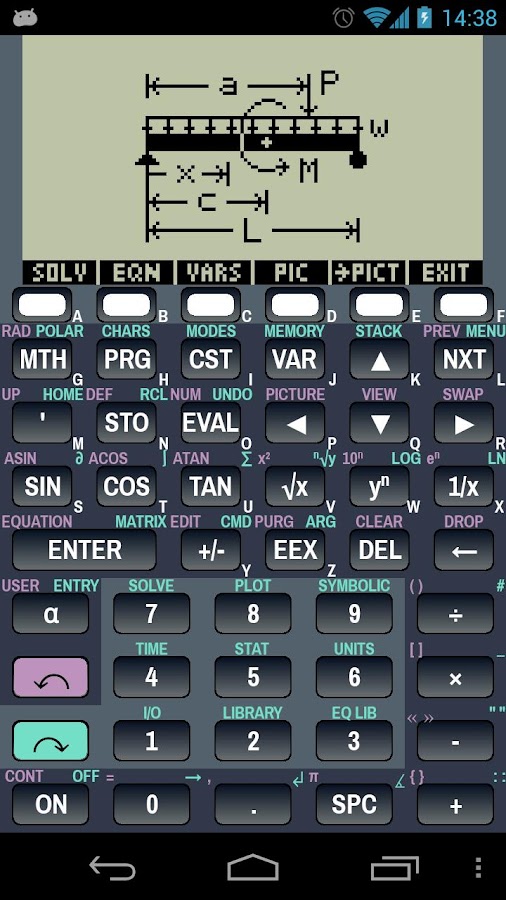
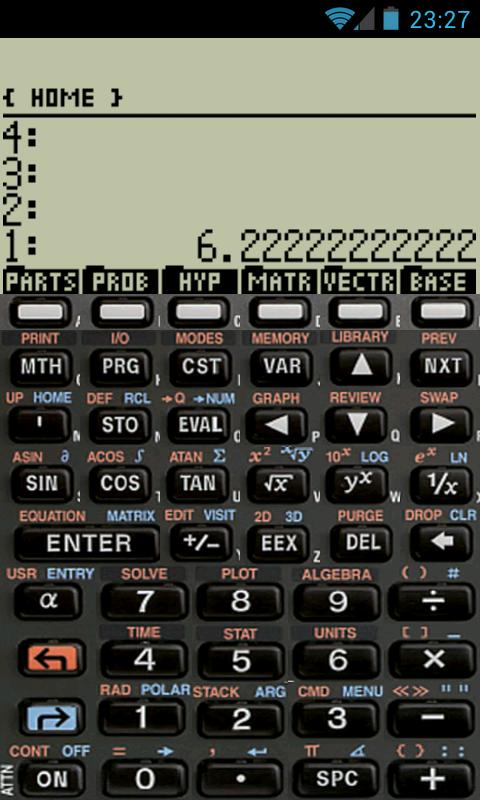
go48g is a really sweet alternative to Droid48. And if you're an HP-41 fan, go41c is a beautiful (and free!) HP-41 emulator.


On iOS, youcan also buy i41cx, an HP-41CX emulator.

Once you've made the leap from free calculators to ones you actually spend money on, your whole world opens up. You can get expandable versions of the HP48 and HP41 series. You can get the HP-12c and all of its sideways brethren. And you can get my personal favorite, possibly the best overall scientific calculator HP ever made, the HP-42S. What? You've never heard of the 42S? Well, that's another story for another time.
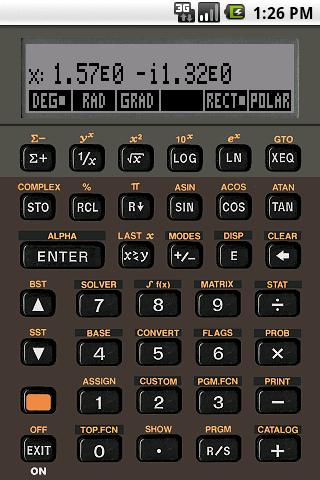
Wait! Don't spend your money yet! Here's an open-source version of the HP-42S emulator! It doesn't use a single bit of HP's ROM images; it merely duplicates the functionality. (Merely? That's a lot of mere.) For iOS (left) and Android (right).

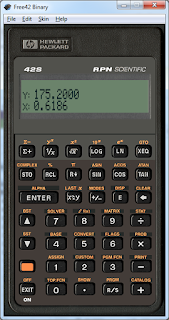
Free42 is also available for Windows, Mac, and Linux operating systems.
A note about those "key players": The HPers who released all of this code into the wild were not the movers and shakers at the top, who nearly drove this once-great company into the ground. They were a tiny number of HP engineers and engineering managers with a combination of passion, integrity and vision that is seldom seen inside HP anymore. I don't know whether they did it with the executive suite's blessing or not, but either way it was a bold move on the part of the engineers and the engineering managers, for which we thank them.
This is still one of the most widely read articles on my blog. That's gratifying. I'm glad to see that it is so useful to so many people.
The SwissMicros version of the HP42 drifts in and out of stock, as do the rest of the SwissMicros calculator product line. Don't let that worry you. It's merely a sign of the craftsmanship with which these beauties are built. (p.s. I want one.)
The Desmos calculators continue to march ahead. More power to them, I say, and to Eli Luberoff and his company. I hope that they make tons of money. Don't worry; their calculators are still free to you, and always will be.
And a final bit of good news: Free42 is not only alive and kicking after 15 years, but it is thriving! It is still in active development. The latest version was released a little over a month ago, in February 2020. If you have followed my recommendation and downloaded this little jewel, consider helping out by clicking on the Donate link on the Free42 webpage and sending Thomas a little cash.
UPDATE, 3 OCT 2019:
There's a Swiss company, SwissMicros, which makes absolutely beautiful replicas of some of the greatest HP calculators: the 10, 11, 12, 15, 16, 41, and 42. Yes, the 42.
There's a new game in town, and it makes the HP and TI calculators as obsolete as dinosaurs. Read this blog article about Desmos.
UPDATE, 27 SEP 2019:
This is one of the most widely read articles on my blog. It's good information. Since Apple did some housekeeping on their App Store, some of the picture links are broken. I've replaced them with local pictures.
In addition, Graphix48 has disappeared from the App Store. I wish I'd saved a local picture of it, because it was good. The developer's web page has also disappeared.
NOW, FOR THE ORIGINAL ARTICLE, 28 OCTOBER 2013:
The first pocket-sized scientific calculator in the world was the HP-35, invented by Hewlett Packard and introduced to the world in 1972. HP literally created the market for handheld scientific calculators. Although many worthy competitors arose, none could match HP's quality, reliability and overall superior design. HP was king of the mountain until Carly Fiorina chose to pull the plug on the calculator division sometime
Carly's excuse at the time was that "calculators are not profitable," which was an outright lie. We won't get into that here. That's water under the bridge. The geniuses who invented such dominant creatures as the HP-12C (the financial calculator that refuses to die), the HP-41 series and the HP-48 series, have moved on to other careers. So has Carly. Around HP, some people still spit after they say her name.
HP calculators have a vast and loyal fan base around the world. Some of those fans were later hired by HP to revive the calculator division, but it was too little, too late, and HP has never reclaimed the market. Like I said, that's a topic for another time, and besides, whining about it won't bring back the glory days.
One of the wisest things HP did, after announcing the dissolution of their calculator division, was release their ROMs into the wild. You can find ROM images, and maybe even source code, for many of HP's calculators online. I believe you can even find source code and emulators for the Saturn and other 4-bit CPUs at the heart of the calculators. (No, I won't include links. Go sniffing for them if you want them.)
Thanks to this wise and generous move by some key players inside HP (see the note at the end), their calculators live on. You can now have an HP calculator app on your iOS or Android device. These emulators work as well as the real things, including support for external storage and printers (on some apps).
My (free) recommendations for iOS: i48 ( two different views)


My (free) recommendations for Android: Droid48 (left) came first. Droid48sx (right) is a beautiful follow-on product.
go48g is a really sweet alternative to Droid48. And if you're an HP-41 fan, go41c is a beautiful (and free!) HP-41 emulator.


On iOS, youcan also buy i41cx, an HP-41CX emulator.

Once you've made the leap from free calculators to ones you actually spend money on, your whole world opens up. You can get expandable versions of the HP48 and HP41 series. You can get the HP-12c and all of its sideways brethren. And you can get my personal favorite, possibly the best overall scientific calculator HP ever made, the HP-42S. What? You've never heard of the 42S? Well, that's another story for another time.
Wait! Don't spend your money yet! Here's an open-source version of the HP-42S emulator! It doesn't use a single bit of HP's ROM images; it merely duplicates the functionality. (Merely? That's a lot of mere.) For iOS (left) and Android (right).

Free42 is also available for Windows, Mac, and Linux operating systems.

A note about those "key players": The HPers who released all of this code into the wild were not the movers and shakers at the top, who nearly drove this once-great company into the ground. They were a tiny number of HP engineers and engineering managers with a combination of passion, integrity and vision that is seldom seen inside HP anymore. I don't know whether they did it with the executive suite's blessing or not, but either way it was a bold move on the part of the engineers and the engineering managers, for which we thank them.
Wednesday, September 25, 2013
Things we don't do with a telephone or television anymore
With the advance of technology, there are some things we no longer do with our telephones or televisions, although we still use the words. For example:
"Pick up the phone" - It used to be that you answered a telephone call by picking up the handset while the phone was ringing. Or you initiated a phone call by lifting the phone off its hook or out of the cradle. Now you have to press a button to answer the phone or dial a number.
"Hang up the phone" - Most phones today, even cellphones, have a "hang up" button. But you no longer terminate the call and disconnect the line by hanging the handset on the hook on the wall.
"Dial a number" - Numeric touchpads have been de rigueur for over 40 years. I can't recall the last time I saw a dial telephone that still worked. Children and many young adults today don't even know how to use a dial phone.
"The phone is ringing" - Telephones today beep, chirp, warble, and blink. They can also sing you your favorite song or make burping or screaming noises to alert you to a call. But if you want a true ringing telephone, you'll have to download an, um, "ringtone" that sounds like a ringing telephone.
"Turn the TV on/off/up/down" - It used to be that every television had a rotary knob, labeled "ON/VOL" or "OFF/VOL". This knob was a combination on/off switch and volume control, and you had to turn the knob to perform any of the named actions. Other electronic gadgets also had rotary on/off switches, and so "turn me on" became a part of the vernacular. Today, rotary switches are a retro fashion, and they often don't have the same mechanical contacts behind them as the old ones.
"Tune in a channel" - The channel selector used to be a rotary dial with stops at channels 2 through 13. Don't ask about the 1. You wouldn't understand. But even if you turned the dial to, say, 5, channel 5 wouldn't come in clearly until you turned the fine-tuning dial to "tune in" the station. "Automatic fine tuning" was a fancy feature on new TVs in the 1970s, but it still didn't work perfectly. Today, you punch a channel number on the remote, and the TV's electronics take care of the fine-tuning for you. In fact, with digital TV, fine-tuning is a thing of the past.
What I said about TVs also applies to radios.
Sunday, September 22, 2013
Feeling sorry for myself: what might have been
A recent tickle from a former colleague on LinkedIn dredged up something from my distant past and sent me on a short tailspin into the Land of What Might Have Been. I'm going to feel sorry for myself, then go to bed and sleep it off. In the morning I'll go to my new job, where I am happy and content and working hard.
This former colleague "endorsed" me for a skill on LinkedIn. She hasn't seen me for about 15 years, so the endorsement doesn't mean much. So I ignored it. Then I fell into my tailspin.
In the late 1990s, I was an extremely competent engineer in my department at Hewlett-Packard. In fact, one year I was the top-rated engineer out of a peer group of about 80 engineers. I was sought after for my technical expertise, my problem-solving skills, and my communication skills. Engineers and non-engineers from other departments came to consult with me.
Our department had three engineering groups. One of the engineering group managers got a promotion, leaving his position vacant. My manager suggested I apply for the position. So did his manager.
I hadn't even considered such a move. I was happy being an engineer. But people had told me over the years that I would make a good manager, and many people had even said, "I would work for you if you were a manager." So I did some research, mainly sounding it out with other engineers and managers, even on the production/operations side, all people whose opinion I valued and trusted. I got unequivocal encouragement from all of them, including votes of confidence from all of the managers, and more "I would work for you" responses from my peers.
The managers' opinions were important to me, because some of them would be on the interview team.
So I applied for the job. I prepped for the interviews. And I did a great job in the interviews. And they gave the job to someone else - one of my fellow engineers was promoted.
Well, she turned out not to be a very good manager. In fact, seeing some of what she did as a manager, I wondered how she had ever gotten the job. I ended up sitting in meetings and on committees with her as the years went by, and - really, this is not sour grapes - she just wasn't very good at management or leadership.
Then HP and Agilent split. We endured wave after wave of layoffs. I never saw any managers get laid off, or any executives. You would think that the Powers That Be would do the math and figure out that they could save more money by firing one incompetent executive than by laying off ten innocent production workers. Or five hard-working engineers. F#$&ing idiots.
Here's the sorry-for-myself "What Might Have Been" part:
Ten years after leaving Agilent, I am still an engineer, but I am making $10,000 a year less than I was back then, and after ten years of struggle, my personal and family financial situation is precarious.
If I had gotten that promotion, I would now be high up in the management ranks at HP or Agilent. I would be a highly respected manager and leader. I would be making $150,000 a year - or more. We would still be living in that big brick house. And my wife would still have the luxury of being a stay-at-home mom, with all the benefits that go with that. My daughters would not have had to scrimp on their weddings. My musical daughter could have gone to Ithaca College instead of the University of Northern Colorado. We would be living free of debt or other financial worries. And we could be using our time and our wealth to help our children and other people, something we have always wanted to do. Instead, we struggle.
That other engineer that got the job? She has changed employers. At least twice. She has changed careers. She has changed husbands. She has changed her last name. She has even changed her first name. And she has changed her appearance so drastically that I don't even recognize her photo on LinkedIn. And she has parlayed that promotion into a Chief Technology Officer position in another state. I don't really know her anymore.
Wednesday, August 7, 2013
Throwing money around "like sewer covers"?
A lot of people don't like Walmart. One of the main reasons is that it's become too big for its oversized britches. Many cities, particularly in the Eastern U.S., are resisting Walmart's attempts to expand buy building in the cities.
Boston mayor Thomas Menino is one of those who don't like Walmart very much. In fact, he dislikes them so much that when Walmart offered to donate to a summer-jobs program in the city, Menino refused their offer. He accused Walmart of trying to buy their way into the city. Said he: "Walmart should settle some of the social issues they have to deal with first before they come to our city and throw money around like sewer covers."
Really, Mr. Mayor? Is that what people do in Boston? Throw sewer covers - er, manhole covers - around?
Wednesday, July 31, 2013
Another good "Out of Office" message.
Here's another good "out of office" message.
The location is Colorado. The date, in case you missed it, is February 28. The intended audience is 12 engineers. Two of them understood the message. Do you?
I’ll be characterizing the performance (simulated vs. actual) of laminated composite low-friction materials against a low-temperature crystalline dihydrogen oxide matrix on Friday the 28th. I expect to spend 7 to 8 hours performing a complicated series of temperature / altitude / insolation shmoos. Back on Monday.
The location is Colorado. The date, in case you missed it, is February 28. The intended audience is 12 engineers. Two of them understood the message. Do you?
Monday, July 29, 2013
Pie
When I was very young, my mother brought out two different kinds of pie for dessert. There was only enough pie for each person in the family to have one piece. But both flavors looked so delicious, that I couldn't choose.
So when she asked me which one I wanted, I said, with all the innocent honesty of a young child, "Both."
She said, "Then you don't get any."
And she meant it.
How many times in our lives are we given a choice between A and B, and told that we can only have one of them? And how many times in our lives does our indecision leave us with neither one?
It was a harsh lesson to learn, at that young age, and the inhibitions that it built into me have burdened me all of my life.
When my kids were young, we brought out two different kinds of pie for dessert. Just like when I was a child, there was only enough pie for each person in the family to have one piece. One of my children looked longingly at both of them, silent tears forming in her eyes.
I said, "Why don't we give you half a piece of each? Somebody else can take the other halves."
And I meant it.
My children learned a different lesson from the one I learned. Not all of them learned that lesson, but the ones that did have gone on in life to sample and enjoy choices A and B, and also C, D and E. Their lives are richer because nobody put artificial limits on their freedom to choose during their formative years.
ADDED JUNE 8, 2024: AN UNEXPECTED THIRD CHAPTER
On June 8, 2024, our kids threw a retirement party for us. The party included at least seven different kinds of root beer, other assorted soft drinks, catered food, and six pies from Perkins. I was enjoying myself and visiting with some guests, when that same daughter, now 40 years old and very accomplished in life, asked me what kind of pie I wanted. I asked, "Can I have half a slice of apple and half a slice of lemon meringue, and someone else can take the other halves?"
She smiled, ran off, and came back with my two kinds of pie. It sounds corny to say, but the circle was complete.
Subscribe to:
Posts (Atom)
